

(Non-contractual photograph / source: BrokenSphere)
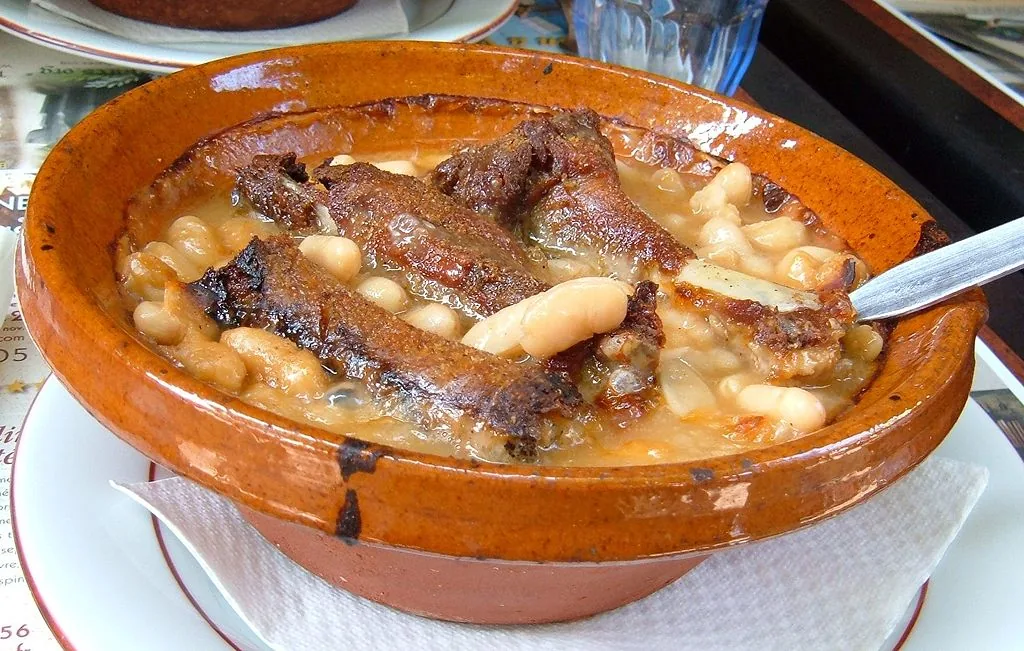
Cassoulet is a main course typical of the Sud-Ouest. A regional culinary speciality of Languedoc, Cassoulet (from the Occitan cassolet, caçolet) is generally based on white beans and pork. It was originally based on broad beans. Cassoulet owes its name to the enamelled terracotta cooking pot called caçòla in Occitan, manufactured in Issel.
The history of Cassoulet
The origins of Cassoulet date back to the Middle Ages. According to legend, Cassoulet was born during the Hundred Years’ War (1337-1453). During the British siege of Castelnaudary, the starving inhabitants gathered everything they needed to feed the town’s soldiers. Thus, the inhabitants stewed in a large earthenware pot bacon, pork, broad beans, sausages and meat. The soldiers from Castelnaudary (that is to say from Castelnaudary), strengthened by this diet, drove the English out of Lauragais and as far as the English Channel! The recipe for Cassoulet was born.
However, this legend, which reinforces nationalist sentiment and makes Cassoulet a defender of French values, does not withstand analysis. Indeed, the town of Castelnaudary suffered greatly during the Hundred Years’ War. Yet, this legend translates a desire for revenge on history. As for beans, originating from the South American continent, they were introduced to Europe much later (16th century). It is therefore more probably a matter of broad beans, or hyacinth beans (moujette or mounjette in Occitan), which are eaten as a stew.
Le Viandier, one of the oldest cookbooks by Taillevent, published on 15 February 1654, contains a recipe for a mutton and broad bean stew. It is probably inspired by the Arabs. But, according to legend, Cassoulet is a main course made from leftovers and very nourishing. Originally, it is a family peasant recipe, composed of seeds (hyacinth beans, broad beans, white beans) and meats. The main course is placed in the corner of the stove early in the morning and left to simmer during the day. It is consumed at the evening meal.
Cassoulet was still called Estouft in the 17th century, but in the 18th century it took its name from “cassole”, named after the dish in which it was prepared. The controversy over the country of origin of Cassoulet was born in the late 19th century when La Revue méridionale published an article in 1890 claiming that the only true Cassoulet came from Castelnaudary.
The question was nationalized around 1900 when the gastronomic critic Edmond Richardin launched a debate on the subject in La Gazette parisienne. Armand Fallières introduced this main course to the table of the Élysée. Today, you can find, in supermarkets, a version of Cassoulet tinned which purists disapprove of. However, the region possesses a very remarkable gastronomic preserve. Its manufacture is highly systematized, but varies from one school to another.
The composition of Cassoulet and its variants
Cassoulet is a traditional main course based on white beans slowly simmered until they melt in the mouth, which is the secret of its success. Depending on the variant, this stew may contain Confit goose or duck, bacon, pork rind, pork knuckle, sausage, lamb or partridge. There are also tomatoes, celery and carrots. It may or may not be covered with breadcrumbs. This is an age-old dispute between the three cities of Castelnaudary, Carcassonne and Toulouse. The controversy concerns the origin of Cassoulet, its composition and the flavour characteristics of the Cassoulet produced in each city.
In Castelnaudary, Cassoulet is composed of white beans from Lauragais, Confit goose, pork knuckle or shoulder, sausage and pork rind, poultry carcass or a few pork bones, onions and carrots.All these ingredients are used to prepare the basic stock for the main course.
However, they are not present in the final product. Cassoulet finishes cooking in a baker’s oven, in which gorse from the Montagne Noire burns.
In the Cassoulet from Carcassonne, you can find red partridge and a piece of mutton.
And finally, the Cassoulet de Toulouse is made up of duck Confit and a Toulouse sausage. A carrot and an onion studded with cloves are also added to it. Sometimes, it is sprinkled with breadcrumbs before being placed in the oven. Experts do not agree on the frequency at which the crust that forms on the surface of the main course should be broken during oven cooking (6 to 8 times depending on the version).
Despite the numerous variations of this main course, we find constants such as the beans which serve as a base, but also various meats including the rind, as well as the cooking pot which enable cooking. In 1966, the States General of French Gastronomy defined the proportions of the ingredients: 30% of meats and 70% of other ingredients such as beans, rinds, aromatics and cooking juice.